Zuiver Wijnen update March 2026 (including invite to L'Absurde Génie on tour!)
Georgian tasting recap, invitation to L'Absurde Génie on tour, Thomas Batardière incoming, non-alcoholic Gut Feeling, Benoît Camus' pure Bojo, finally Denavolo and more!
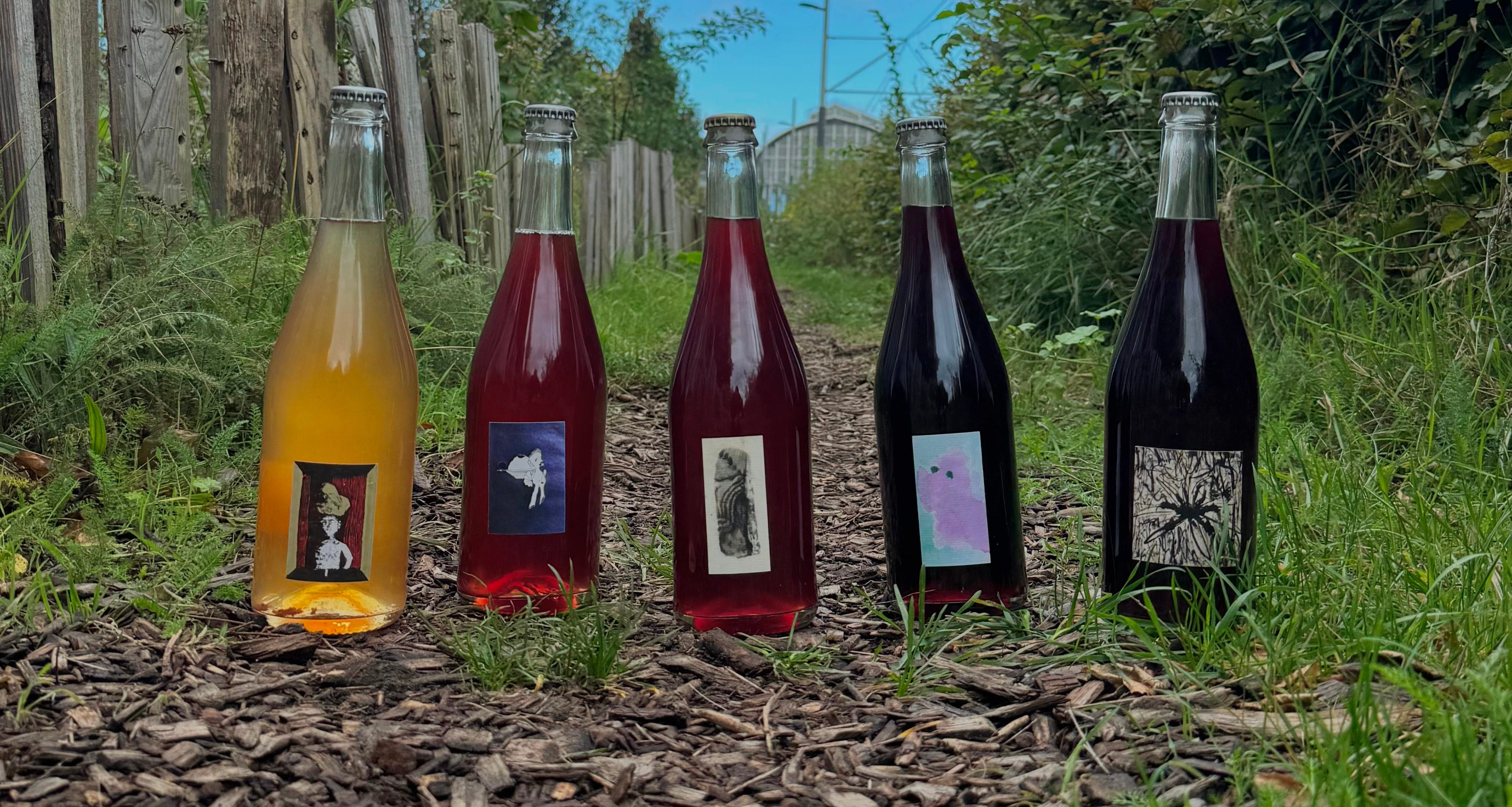
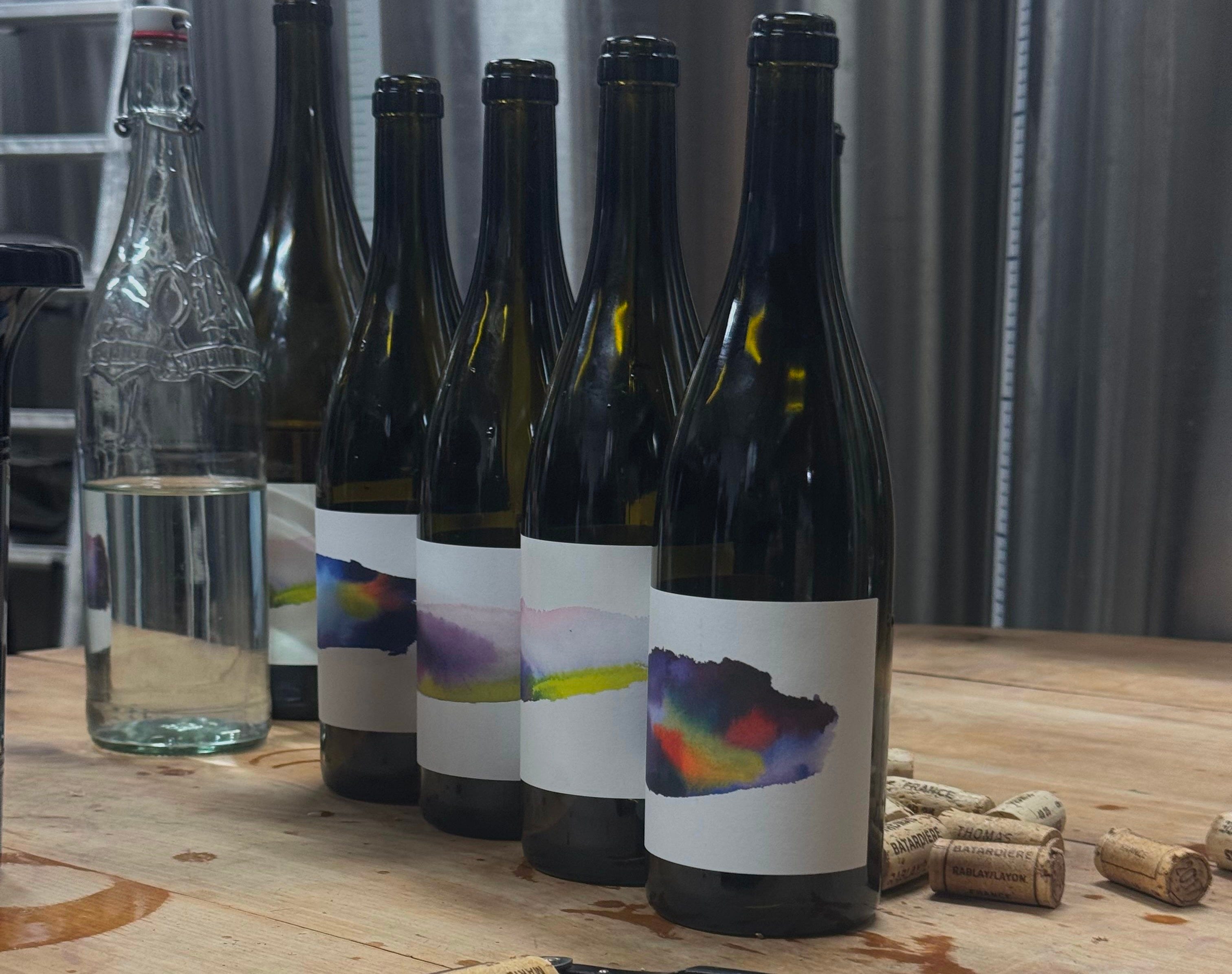
A small selection of the 2024-vintage ready for the Absurde Génie tour!
Dear all,
Spring is fast approaching, and the winemaking world in the Northern Hemisphere is preparing for the 2026 growing season. Pruning has already been completed in many vineyards, and in some places the first buds will begin to appear this month. Once the first shoots start to grow, most of the winemakers we work with will retreat almost entirely to their vineyards, focusing on their own pieces of (un)controlled nature.
Fortunately, Miha & Tom of L’Absurde Génie des Fleurs have planned their work well this March and have made time for us. We are therefore delighted to invite you, through this newsletter, to the three-day Absurde Génie tour in Amsterdam and Rotterdam, which we are organizing together with them from 22 to 24 March.
In addition to the invitation to what promises to be a fantastic three-day program, this newsletter also covers the recently tasted new Georgian vintages, as well as the fact that we expect to receive the first wines from Thomas Batardière shortly.
Furthermore, we are also receiving new wines from Benoît Camus (including his fantastic Beaujolais Blanc), and we are hoping to finally actually receive new wines from Denavolo, along with the alcohol-free creations and new Maskerade cuvées from Gut Oggau. Due to issues with one of our regular transporters, the January and February pick-ups at Denavolo and Domaine Otter unfortunately did not take place, but we expect to be able to deliver these new wines in March.
Finally, on the last Sunday of March, we will be pouring an entire afternoon of Central and Eastern European fireworks at our friends at Cornerstore, where Milan Gataric of Restaurant Lux will prepare a true Central European feast.
Read on below for the invitations to the Absurde Génie tour and the Sunday at Cornerstore, the highlights from the Georgia tasting, and all the wine news.
L’ABSURDE GÉNIE DES FLEURS ON TOUR (22, 23 & 24 MARCH)
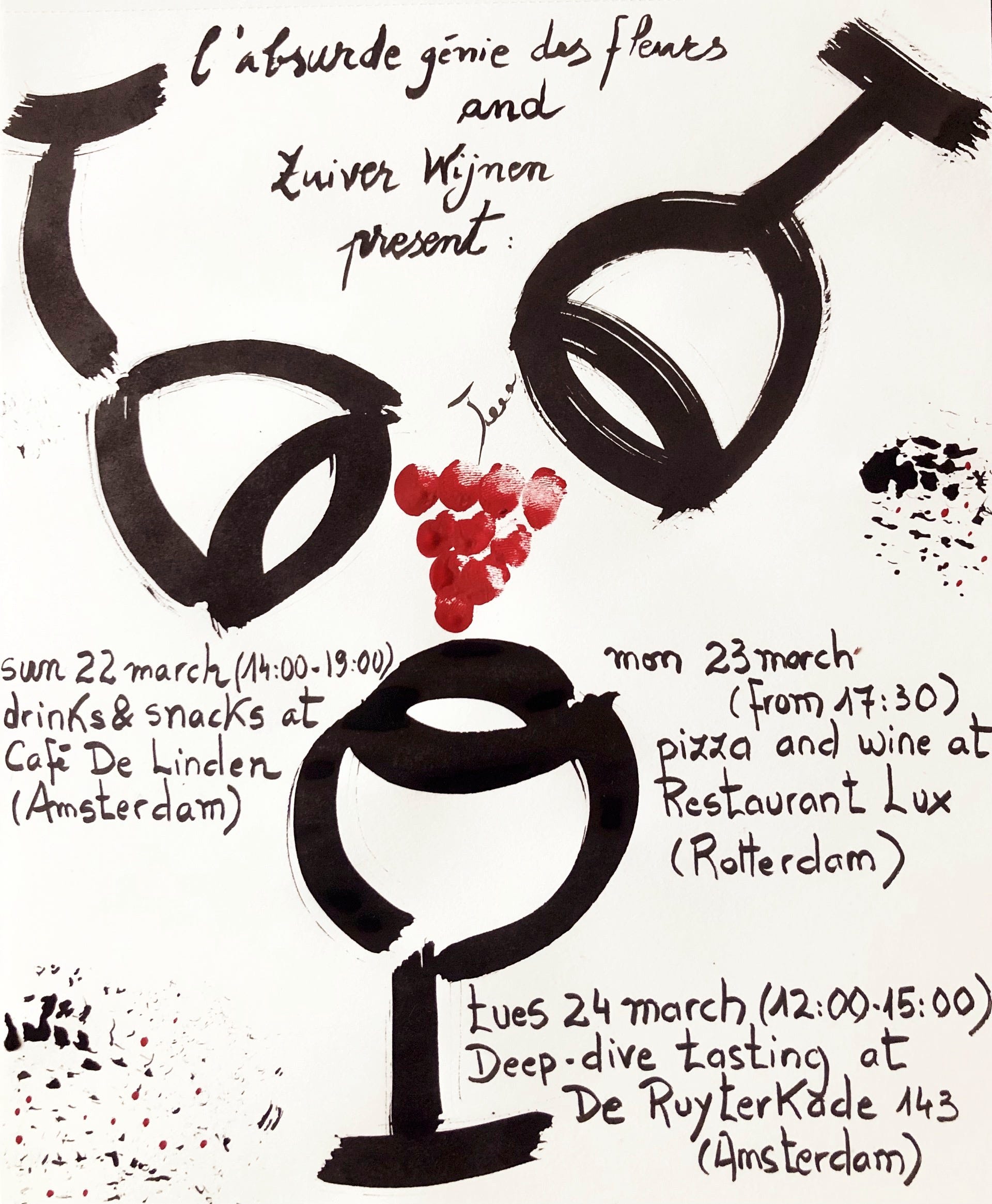
The poster for the Absurde Génie-tour was made by Miha Trifa of L’Absurde Génie des Fleurs, in true Absurde style!
As we are planning to release the new 2024s from one of our favorite domaines this spring — after a period of cellar aging — we are organizing three events together with Miha & Tom of L’Absurde Génie des Fleurs on Sunday 22, Monday 23 and Tuesday 24 March to present these wines.
For about ten years now, Miha & Tom have been crafting ultra-natural wines in the forested, hilly landscape of the Hérault, in the northern part of the Languedoc. From often very old vines, they produce wines that are light and drinkable, yet immensely expressive. They learned the craft in part from Axel Prüfer, who is known for harvesting the same vineyard at different moments. For many cuvées, Miha & Tom harvest multiple times, bringing together grapes at different levels of ripeness into wines that are always perfumed and aromatic, with beautiful acidity and striking minerality. Short macerations and the infusion of whole bunches in directly pressed juice contribute to freshness, while the age of the vines and extremely low yields — the result of limited pruning and never ploughing — ensure depth and complexity.
The duo’s range now includes around fifteen cuvées, spanning from light orange and rosé to the full spectrum of reds, partly made in Georgian qvevri buried outdoors in front of their new cellar in Clairac. Only a few hundred bottles of each cuvée are produced annually, and each year, Miha paints new labels, giving the bottles and cuvées fresh faces, depending on how the vintage and the particular cuvée feels. Not only the looks are great, as these are wines we deeply desire, and would not hesitate to bring to a desert island, and these are certainly wines that are amongst the wines we like to drink in our free time the most.
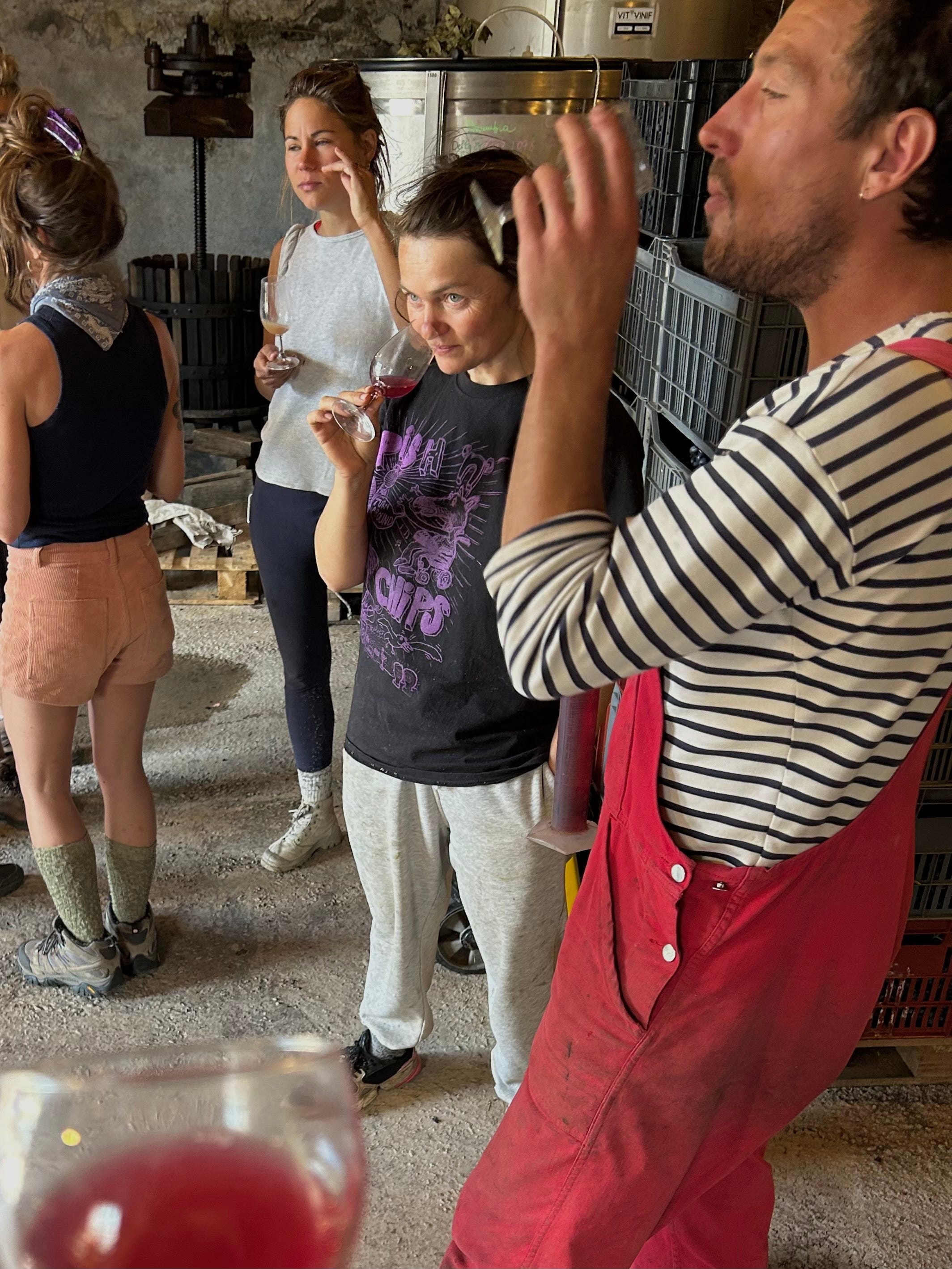
Tasting the 2024 juices with Miha & Tom in the cellar in Clairac, September 2024
Miha & Tom’s wines rarely fail to make us grin from ear to ear and giggle with joy. It’s exactly that positive energy we hope to share with you on Sunday 22, Monday 23 and Tuesday 24 March. Please find the full program below.
Miha & Tom will be pouring all their new 2024 wines by the glass at Café De Linden in Amsterdam. All 2024s will also be available by the bottle at friendly prices. We will also open a few older magnums and aged Absurdes in limited quantities, available both by the glass and bottle. And of course, there will be food to keep you well sustained.
Wines will be poured between 14:00 and 19:00. No reservations required.
At Restaurant Lux, Milan Gataric will prepare a three-course menu featuring fritto misto, pizza giardino and tiramisu, accompanied by the wines of Miha & Tom. The wines will be available by the glass and bottle at accessible prices. Miha, Tom and our team will be there to pour, explain and elevate the festivities.
Reservations can be made from 17:30 via the website of Restaurant Lux. The three-course menu is priced at €35.
Tuesday 24 March – Deep dive tasting at De Ruyterkade 143, Amsterdam
Miha & Tom will host a ‘deep dive’ tasting, exploring in depth all facets of natural winemaking in the Hérault, their recent vintages and their full range — and, knowing them, also a touch of the esoteric and a thousand-and-one other subjects.
This deep dive tasting will take place from 12:00 to 15:00 at our soon-to-open new location at De Ruyterkade 143, just down the street fromRestaurant Choux.RSVP via info@zuiverwijnen.nl.
We will send an official invitation and reminder somewhere mid-March, but we simply couldn’t keep this good news to ourselves any longer…
RECAP ANNUAL GEORGIAN PORTFOLIO TASTING
On Monday 16 February, we tasted around 50 new wines from the 2024 and 2023 vintages at Restaurant Choux, from thirteen different producers we work with at Zuiver Wijnen. We were hugely impressed by the quality and drinkability of this new release. In recent years, the Georgian wines have occasionally faced some challenges — particularly in 2022. Changing climatic conditions led to difficult fermentations, unusual tannin structures and, at times, instability. With sufficient time, many of these issues resolved themselves, but the wines did not always start off as smoothly as usual.
Fortunately, the latest 2024s and 2023s showed beautifully at the tasting: open, vibrant and surprisingly coherent. Below is a recap with favorites and highlights.
TABLE 1: IAGO & MARINA, RAMAZ NIKOLADZE AND THE GUNIAVA FAMILY
The first table featured the wines of our favourite Kartlian producers, Marina and Iago Bitarishvili. Their annual recipe is, in principle, the same: six to seven months of skin contact with whole bunches on Mtsvane and Chinuri respectively. Iago’s Chinuri was smoky, waxy and saline, while Marina’s Mtsvane 2024 was beautifully tropical on the nose, with great power on the palate, enormous length and a savory undertone. Both wines of exceptionally high quality — and, thankfully, highly drinkable.
Alongside Marina & Iago stood the wines of Ramaz Nikoladze, a close friend of the pair. The crowd favorite was the light red blend of red Dzelshavi and white Tsolikouri: a true ‘blouge’, as trendy wine drinkers might call it. Whatever the label, it was a fantastically fresh, light red glass with bright berry fruit and concentration that drank like water. We ourselves were also impressed by the longer-aged orange Tsolikouri (Solikouri Orange 2023, six months of skin contact, made ‘the Kakhetian way’), with its fine texture, spicy pepperiness and beautiful depth, without becoming heavy.
TABLE 2: MAKARIDZE, IGAVI WINES AND FREYA’S MARANI
Table 2 was packed with Imeretian firepower from three of our favourite zéro-zéro producers from the West: Makaridze by Gogita & Keto, newcomer Igavi Wines by Aidan Raftery, and Freya’s Marani by Enek Peterson.
From Makaridze, the lightly volatile, energetic Aladasturi Rosé 2023 was the standout: racy, uplifting and wild yet elegant. Despite the transparent bottle reminiscent of Provence rosé, this was its absolute antithesis — pure, untamed and alive, with no desire whatsoever to fill the glass with ice.
We also tasted four fantastic wines from Igavi Wines, which produces wines in both Imereti and the volcanic mountain region of Lechkhumi from old, forgotten indigenous varieties such as Orbeluri Ojaleshi (our favorite: elderberry-driven, savory, grassy and super saline) and the somewhat better-known white Tsolikouri (aged in old Georgian acacia barrels, giving the wine a waxy, incense-like character). The Vanis Chkhaveri rosé and the light red Aladasturi were equally bursting with energy.
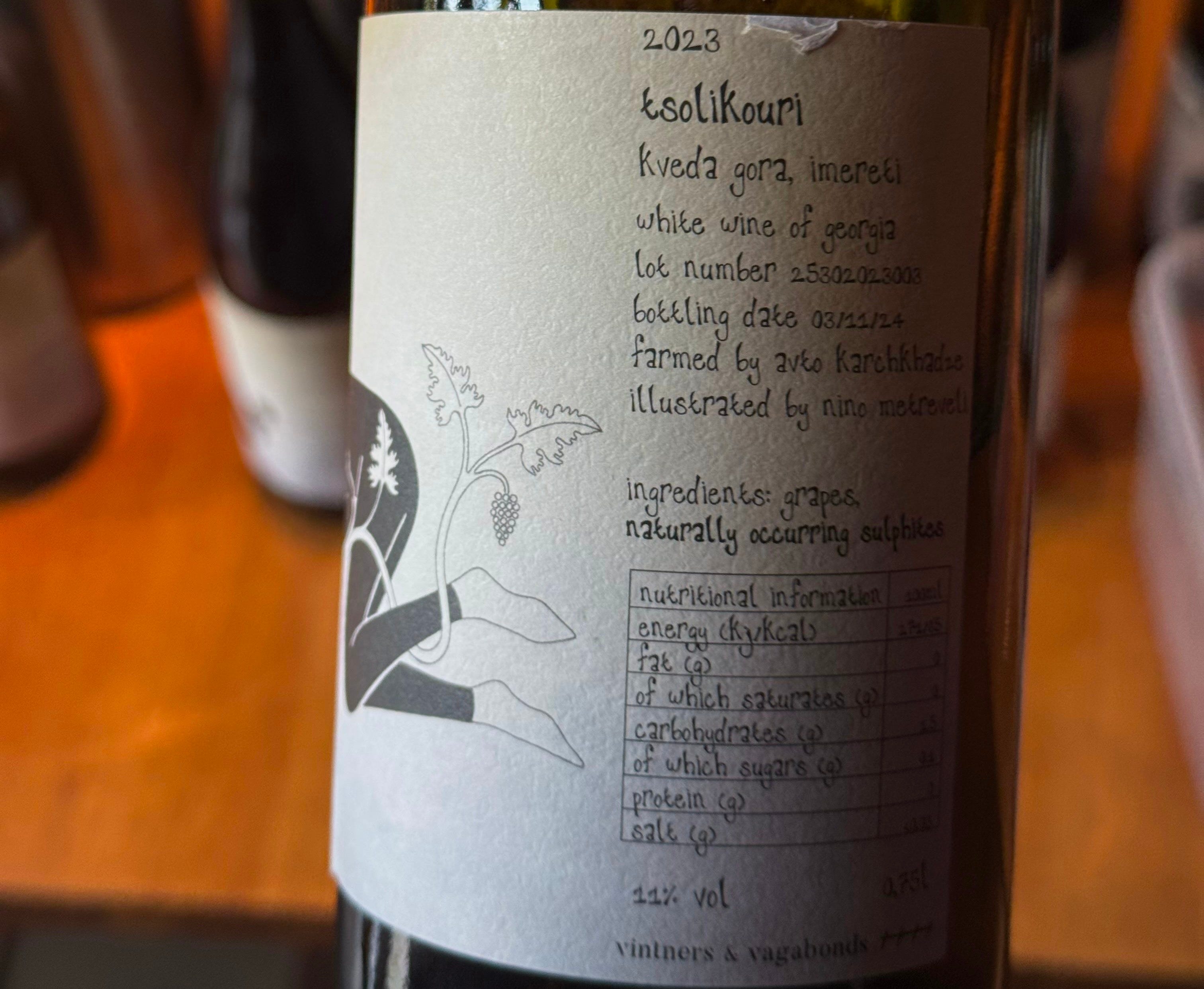
Igavi’s Tsolikouri 2023 from Imereti during the tasting, February 2026
Freya’s Marani’s white Queen Of The Night 2023, made from Tsolikouri and Krakhuna, overwhelmed us with its elegance — almost reminiscent of white Jura, but without the dominance of oak. Wine with a capital W. Also, — we say it often, but never often enough — Aladasturi truly still is our favorite Georgian grape, especially in the form of Ariqa 2024.
TABLES 3 & 4: PHEASANT’S TEARS, MANAVI AND GOGO WINES
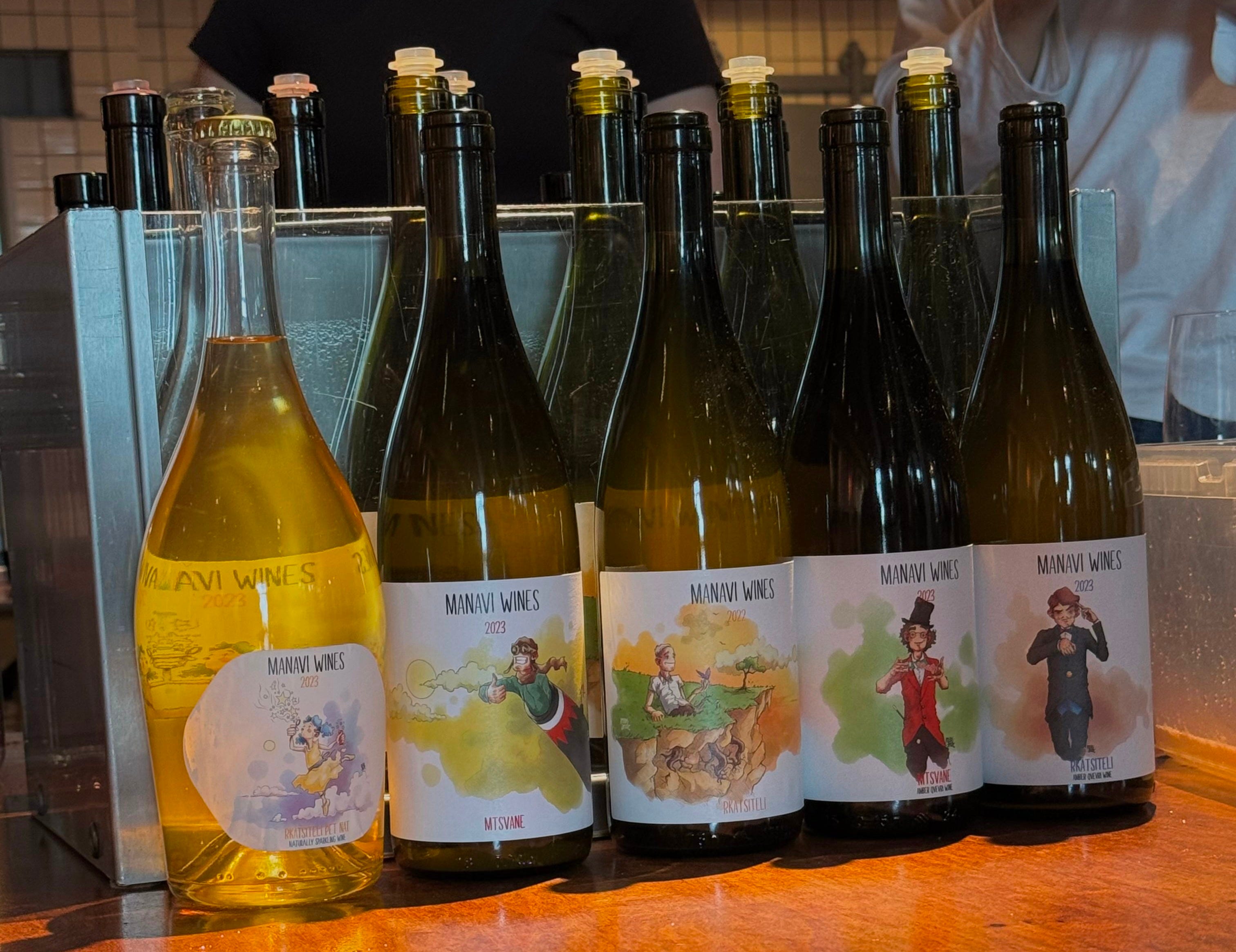
New wines by Manavi during the tasting, February 2026
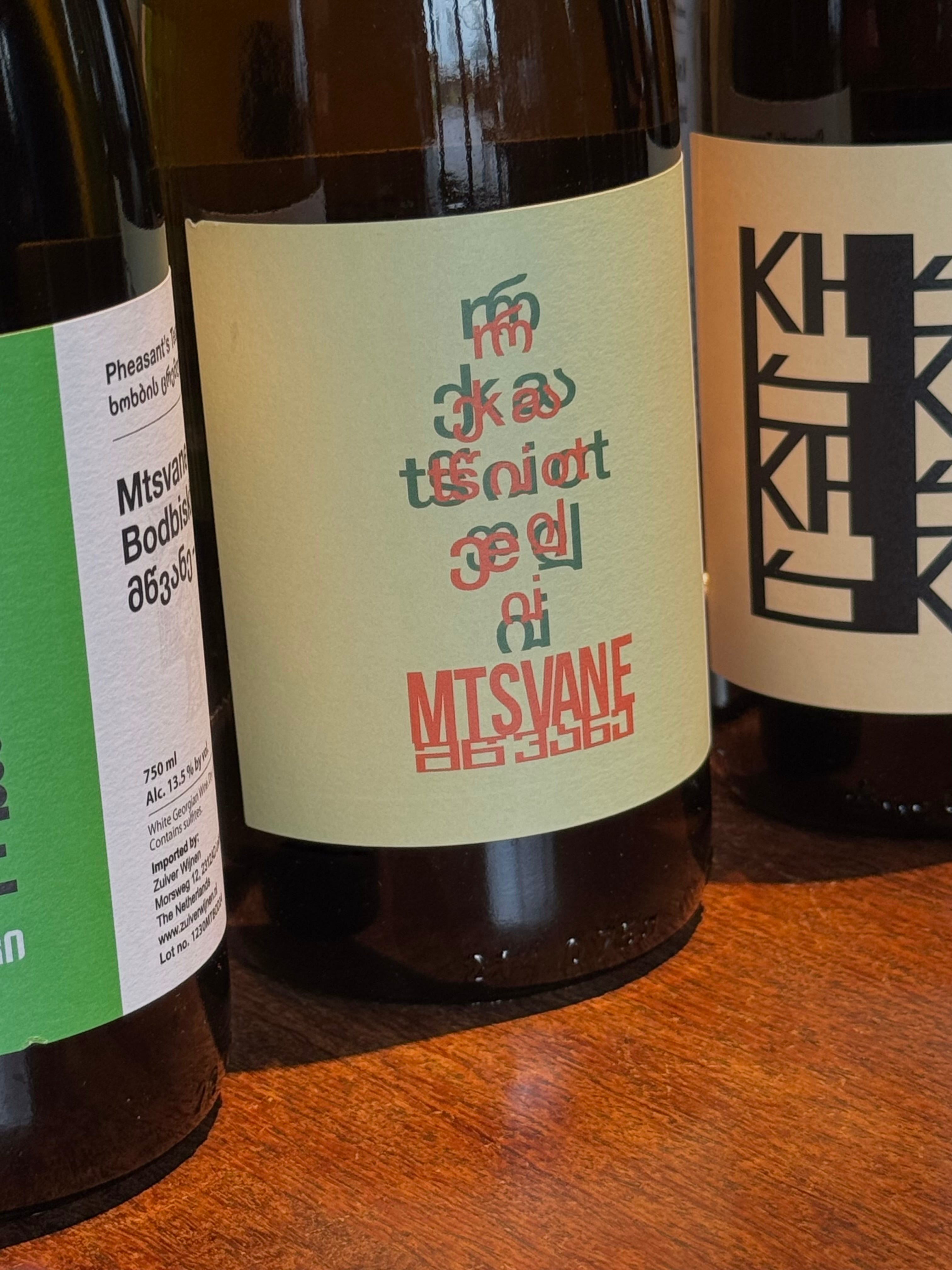
From Pheasant’s Tears we tasted no fewer than ten wines, including the seaweed-tinged white Tsolikouri 2024, the tropical white Mtsvane Bodbiskhevi 2024 (fruity, with a hint of not-distracting residual sweetness and beautiful acidity), the new light orange Loire-like blend of Rkatsiteli and Mtsvane, the serious orange Rkatsiteli Tibaani 2024, and the muscular, show-stopping Khikhvi 2024. The light-red yet textural Poliphonia 2024 — made from more than 110 different white, red and pink grape varieties — was another highlight. Across the board, the wines were less rough than they were in some vintages in the past, and there were simply too many delicious wines to choose a single favorite…
Giorgi of Manavi Wines crafts his wines between Tbilisi and Sighnaghi, in the lush green microzone of Manavi. The wines benefit from the warmth of Kakheti, making them expressive and ripe, yet thanks to cooling influences and a more humid climate they retain a joyful, fresh-tropical core and a less austere Eastern Georgian profile. Favorites: the iced-tea-like sparkling Rkatsiteli Pet Nat and the orange Rkatsiteli–Mtsvane Amber 2023, almost reminiscent of Roussillonais Muscat, yet with a distinctly Georgian (polyphonic?) undertone.
New blend of Rkatsiteli and Mtsvane by Pheasant’s Tears, February 2026
The wines of Ketevan from Gogo Wines in Artana, north-eastern Georgia, were back to the level which we fell in love with a few years back. After some disastrous vintages losing all her grapes, she finally was able to produce a vintage entirely from her own vines: from the white Ça-Tourne 2024 and the lightly orange Rkatsiteli Ti Sogno Bene 2024 to the fantastic, sultry, almost Cascina Tavijn-like (!) red blend L’Anamour 2024 (apricots, roses, leather, clove), everything was outstanding. Welcome back!
TABLE 5: TAMUNA AND ANDRIAS GVINO
At the final table, we tasted Chinuri from 90-year-old vines by our friend Tamuna. Shortly after the start of the tasting, a loved restaurant client reserved the remainder of our stock, but fortunately it could still be admired during the tasting itself… Soon by the glass on the Ten Katestraat!
Alongside stood the wines of Andrias Gvino (George Wolski), who makes wines which are are among the most sharply priced of the Georgian wines. Andrias Gvino produces natural wines with absolutely no additions, stylistically consistent and almost classically Georgian in feel: powerful wines at modest prices, with serious texture thanks to long maceration and qvevri aging, clearly expressing their grape varieties without becoming overly stern or rustic. Favorites: the aromatic Khikhvi, the walnutty Kisi and the archetypal Georgian Saperavi 2022. Bold and beautiful — we can hardly resist hopping on the next plane to Tbilisi ourselves…
All wines have been available for our professional clients from last week on, and we have started (slowly) phasing in new wines online and on the physical shelves also. However, as shelf-space is limited, not all wines are available online currently. As soon as we re-locate somewhere in April, this won’t be an issue anymore. For all info or if you are in need of a certain cuvée which is not available online, feel free to get in touch, and we’ll make sure to get you the right bottles.
FOCUSSED WHITES FROM CHENIN-MECCA RABLAY: MARIE-LISE & THOMAS BATARDIÈRE
During the weekend of our annual Loire fair visits, we were invited by Thomas Batardière to come visit him through friends of friends, who together with his wife Marie-Lise is currently producing some of the most sought-after, razor-sharp, schist-driven Chenins in Rablay-sur-Layon — the mecca of Chenin Blanc (after the wines of direct neighbor, close friend and mentor Richard Leroy, of course…).
The couple farms 3.8 hectares of white Chenin Blanc and 0.2 hectares of light red Grolleau, and the white Chenins — the true focus here — come primarily from single-parcel vineyards. These vineyards are planted on various compositions of Rablay’s famed schist soils in Anjou, all within cycling distance of their cellar. This modest surface area is just large enough for Marie-Lise and Thomas to tend entirely by themselves throughout the year, and all parcels are close enough that the bicycle serves as their main means of transport between vines and cellar.
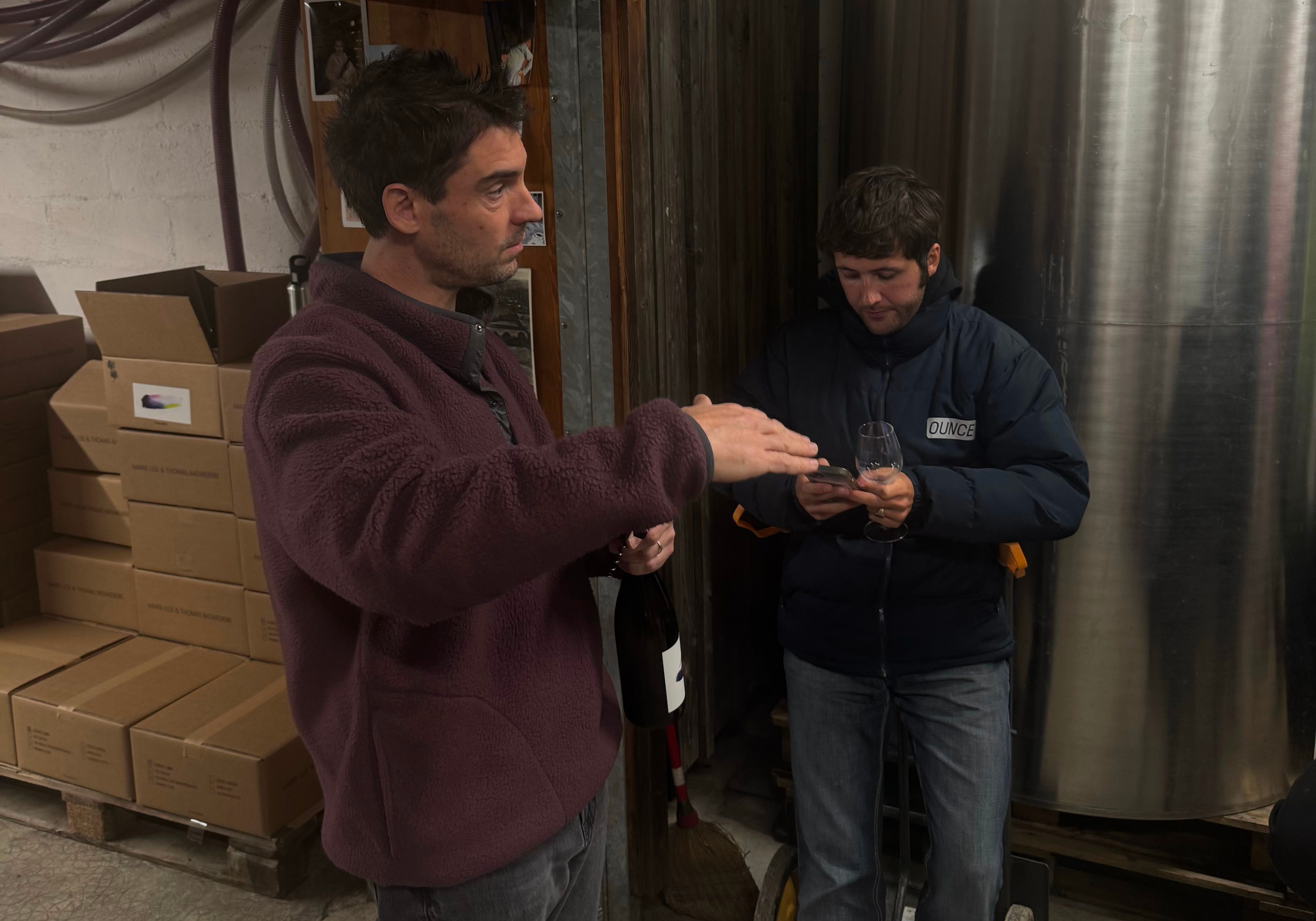
Thomas in the cellar, Job taking notes diligently, February 2026
The recipe for the whites is, in essence, beautifully simple. The only differences between the cuvées arise from terroir, vine age and vineyard exposure. The grapes are gently direct-pressed, ferment in stainless steel, and then age for one year in large foudres, where the wines are left completely undisturbed. After this year, they are racked back into stainless steel to settle, and then bottled by gravity. No sulphites are used at any stage of the process, and in principle nothing is added at bottling — except in specific cuvées during problematic vintages. The last time a small amount of sulphur was used at bottling was for one cuvée in the 2022 vintage; otherwise, Thomas prefers to add nothing at all.
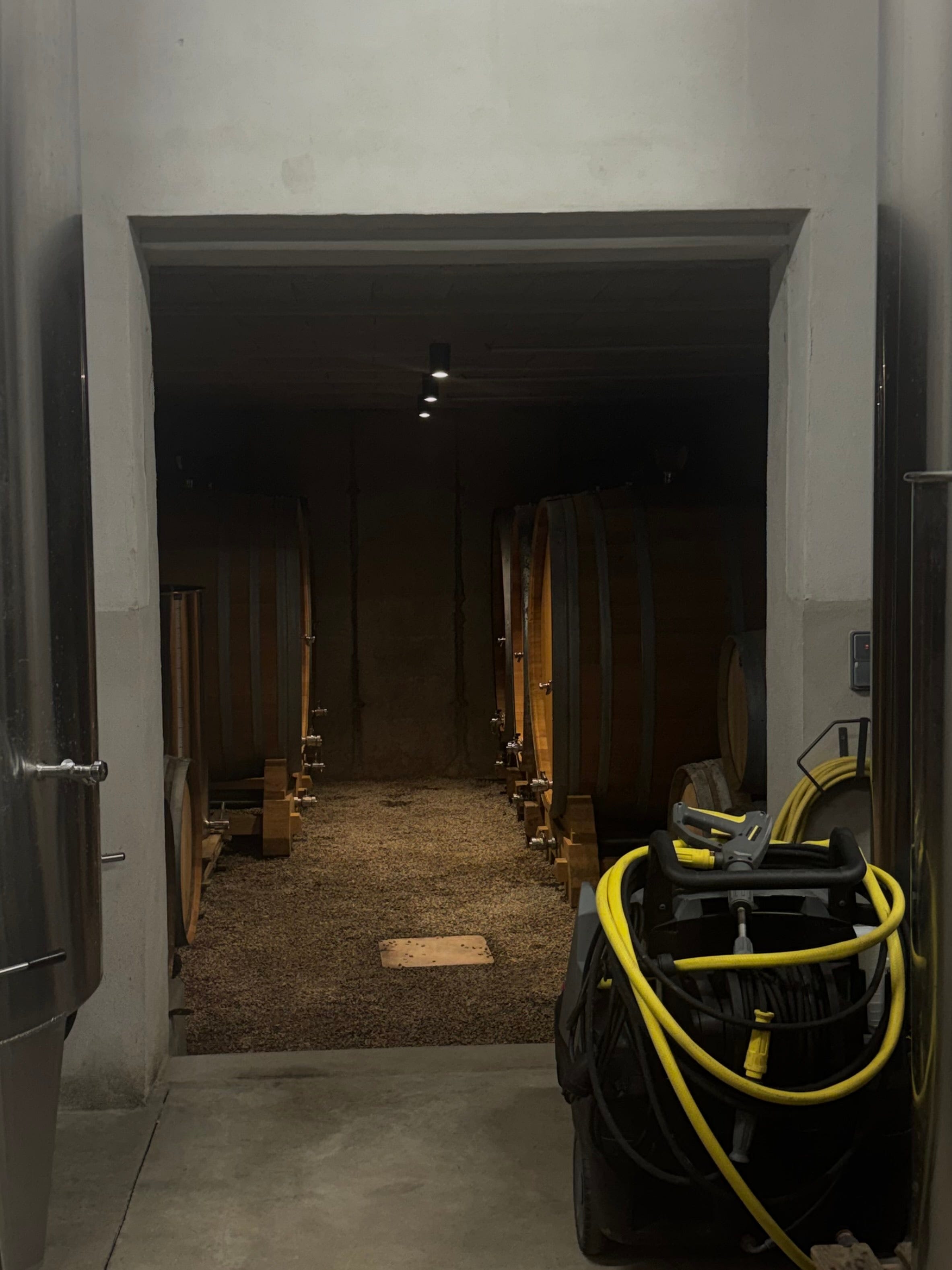
Foudres for the whites and barrels for the red in the cellar, February 2026
Despite arriving somewhat sheepishly with a slightly larger group than expected around Sunday lunchtime, we were welcomed by Thomas with warmth and a huge friendly smile. We were immediately invited into the cellar to taste the recently bottled 2024 vintage — the wines we will receive and allocate in March.
We began with Le Grand Clos 2024 and L’Esprit Libre 2024. L’Esprit Libre, from the estate’s oldest vines, showed the most vibrant fresh stone fruit, while Le Grand Clos carried deeper, stonier, lightly smoky Chenin tension.
The third wine poured was Les Cocus 2024. Here the intense schist power came fully to the fore — the texture was so serious it almost suggested skin contact. The Clos des Cocus vineyard lies right next to Montbenault and consists largely of old vines planted in the 1960s. The wine burst with life, yet remained calm, elegant and grand. Thomas quietly admitted that although his other cuvée, Les Noëls de Montbenault, is the most sought-after, Les Cocus is Thomas’ personal favorite.
The fourth white was the illustrious Les Noëls de Montbenault, made famous in part by neighbor Richard Leroy. Compared to Les Cocus, this vineyard contains even more volcanic rock, giving the wine a stronger savoury, umami tone. These last two wines were monumental, showing vast differences in texture, aroma and minerality — even though the grapes were harvested within the same few days and received exactly the same élevage.
The white spectrum by Marie-Lise en Thomas Batardière, February 2026
After this 2024 Chenin masterclass, Thomas poured several aged wines, including L’Esprit Libre 2017 and Grand Clos 2019. It was immediately clear where these wines evolve with time. In youth, they are packed with laser-sharp acidity, intense texture and savoury drive; with age, they fan out, release perfumed aromatics and become silky in texture. The tasting demonstrated that the 2024s shine like the sun in their youth, yet with bottle age can feel like a warm blanket, without losing their energy.
We will receive only a few cases of each cuvée. Once the wines arrive, we will announce this via our Instagram. As we aim to distribute them as fairly as possible, we recommend getting in touch if you are interested. We will ensure that everyone has an honest chance to secure some of these white 2024s.
DELICIOUS(LY HONEST) WHITE AND RED BEAUJOLAIS BY BENOÎT CAMUS
On the morning before our visit to Marie-Lise & Thomas Batardière, we tasted with many winemakers — including our friend Benoît Camus — at the zéro-zéro fair Les Anonymes, held at the Salle Curnonsky in Angers.
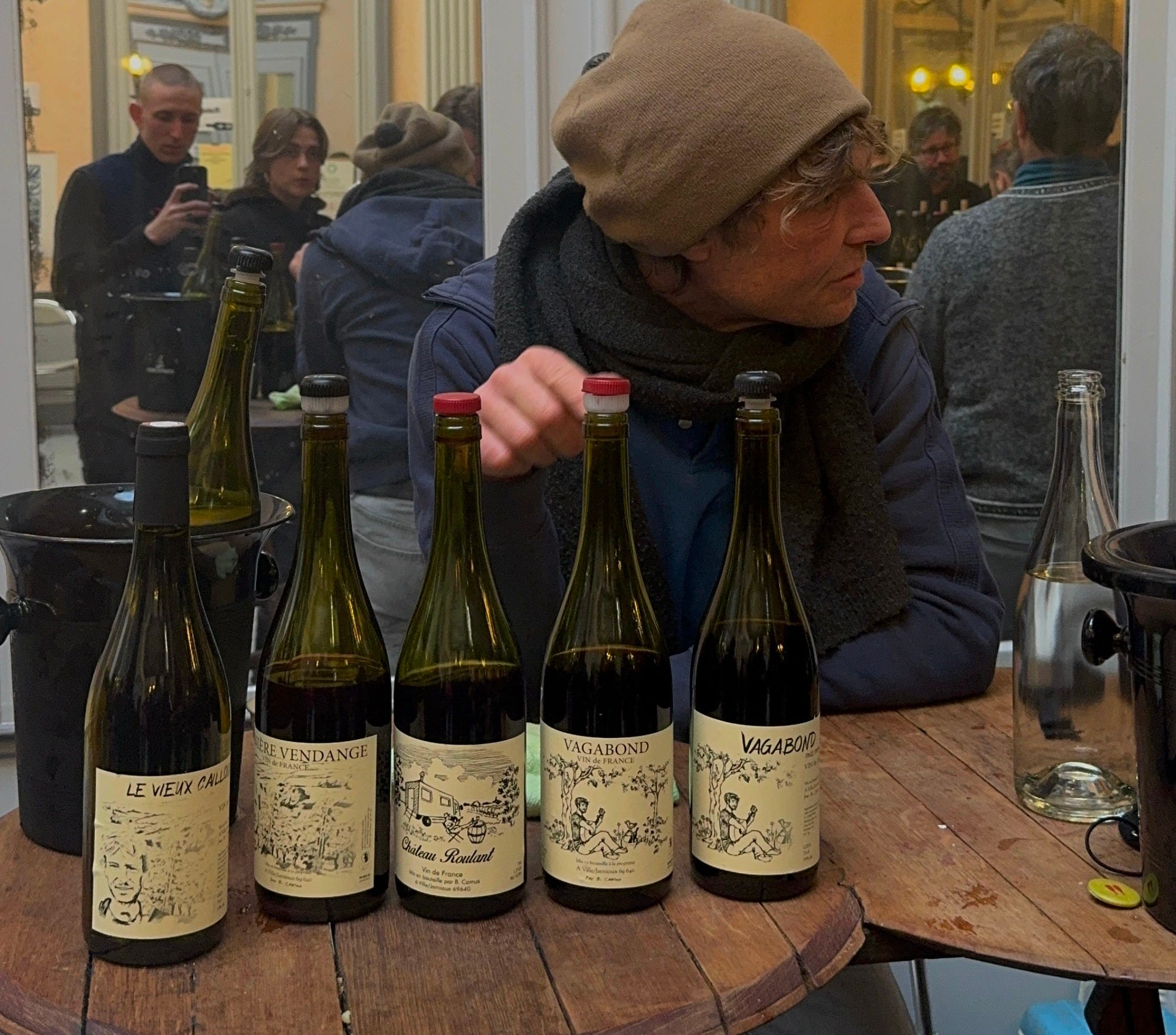
Benoît works (and lives) among his vineyards in Ville-sur-Jarnioux, nestled in the hills of southern Beaujolais. He produces wines primarily from Gamay, with a small proportion of Chardonnay. Each year, we happily meet Benoît at Les Anonymes, where he presents his newest bottlings with with well-earned pride and an and infectious energy.
Benoît with his new wines at Les Anonymes, February 2026
The tasting began with a new cuvée for us, which we had previously sampled from tank during our visit in April 2024: Vieux Cailloux 2022, made from 100% Chardonnay. At the time of our earlier visit, the wine was cloudy, semi-sweet, reduced and quite wild; now it had fully settled and found its balance. The tropical notes of a fine Beaujolais Blanc came through beautifully, with a crystal-clear core and a saline, toasty minerality that many a Burgundy producer might envy. As Benoît works exclusively with fibreglass and concrete, the wine is untouched by oak, remaining light and elegant, and it felt like it was white Bojo’ of a time long-gone.
Next, we tasted his unofficial primeur, Dernière Vendange 2025 (‘Past Harvest’): ripe-picked Gamay, bottled in November 2025, brimming with vivid fruit and juiciness. Gamay in its purest form — unbelievably delicious and vibrant.
This was followed by the cult classic Château Roulant 2021/23, for which Benoît blended the fresh 2021 vintage with the richer 2023 to create his balanced ‘Rolling Castle.’ Compared to Dernière Vendange, it was slightly earthier and more tobacco-tinged, as proper rural Beaujolais should be, yet still driven by berry fruit with a subtle tamari-like nuance.
We also tasted the ‘biggest’ of the three Gamays, Vagabond, which is always a touch richer, with notes of cherry fruit, raisins and white pepper. Fortunately, we had already stocked up generously on this cuvée and still have it available.
More honest, delicious and free of embellishment than Benoît’s wines is increasingly rare in today’s modern, high-tech wine sector — and thankfully, the prices remain distinctly Beaujolais: refreshingly sharp. The three new wines (Vieux Cailloux, Dernière Vendange and Château Roulant) will be available from mid-March; Vagabond is available online already.
QUICK NEWSFLASH 1: GUT OGGAU’S GUT FEELING AND MASKERADE’S ARE FINALLY ON THEIR WAY
Last month we already wrote about the arrival of Gut Oggau’s new alcohol-free sparkling drink, called Gut Feeling (€17), as well as the sharply priced white and rosé Maskerade cuvées (both €18,50 online). Due to logistical issues, the sparkling wines and cuvées were somewhat delayed, but they have now finally been added to the product list, and will be available online this month too. Below you’ll find the text from last month’s mailing.
In November, during our portfolio tasting, Stephanie & Eduard of Gut Oggau told us that a a number of new drinks were in the works, including the return of the well-priced Maskerade cuvées and a non-alcoholic beverage (!) made using ingredients for their biodynamic fields in Burgenland.
The new Maskerade cuvées are one white and one deep pink blend of white and red grapes, showcasing Oggau’s signature limestone minerality, precise aromatics, and lively acidity (and all bottled under crown cap to preserve the freshness), which sounds like the recipe for the perfect spring wine. It will be well-priced, and will be somewhat more affordable than the more serious Theodora, Winifred and Atanasius, making it easy to pour a little extra Oggau.
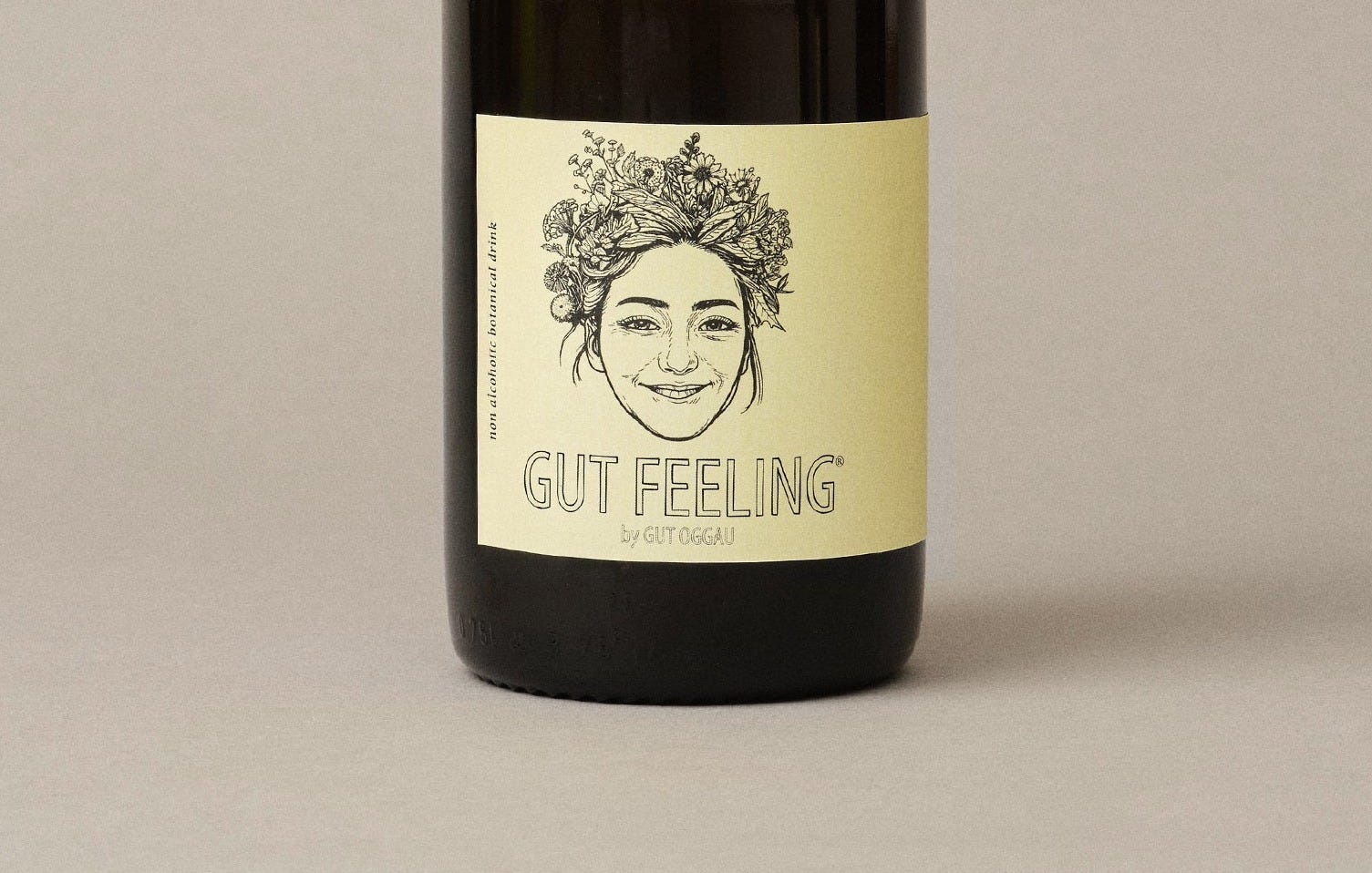
Besides new wines, Stephanie & Eduard made a non-alcoholic beverage, which we were eagerly waiting for since the portfolio tasting in November. Eduard brought a sample of the new cuvée called Gut Feeling last November, which is a fermented, non-alcoholic herbal infusion, which they bottled and labeled this winter. Gut Feeling is made from aromatic herbs grown in the vineyards and uses the estate’s own flower honey for bottle fermentation. Herbs such as chamomile, yarrow, dandelion, wormwood, and nettle are infused, while the honey drives the (non-alcoholic) fermentation. The result is a refreshing, lightly sparkling, aromatic, and complex non-alcoholic beverage — perfect as an aperitif or a non-alcoholic alternative that isn’t overly sweet.
Gut Feeling!
QUICK NEWSFLASH 2: NEW WINES BY DENAVOLO AND SHUN MINOWA NOW ALSO FINALLY ON THEIR WAY
Just like with the Oggau wines, we also wrote last month about the arrival of the wines from Denavolo and Shun Minowa. After several attempts, these wines have now finally been collected and are on their way to the Netherlands. All new wines have been added to the product list, and will be available online soon too. Below you’ll find the text from last month’s mailing.
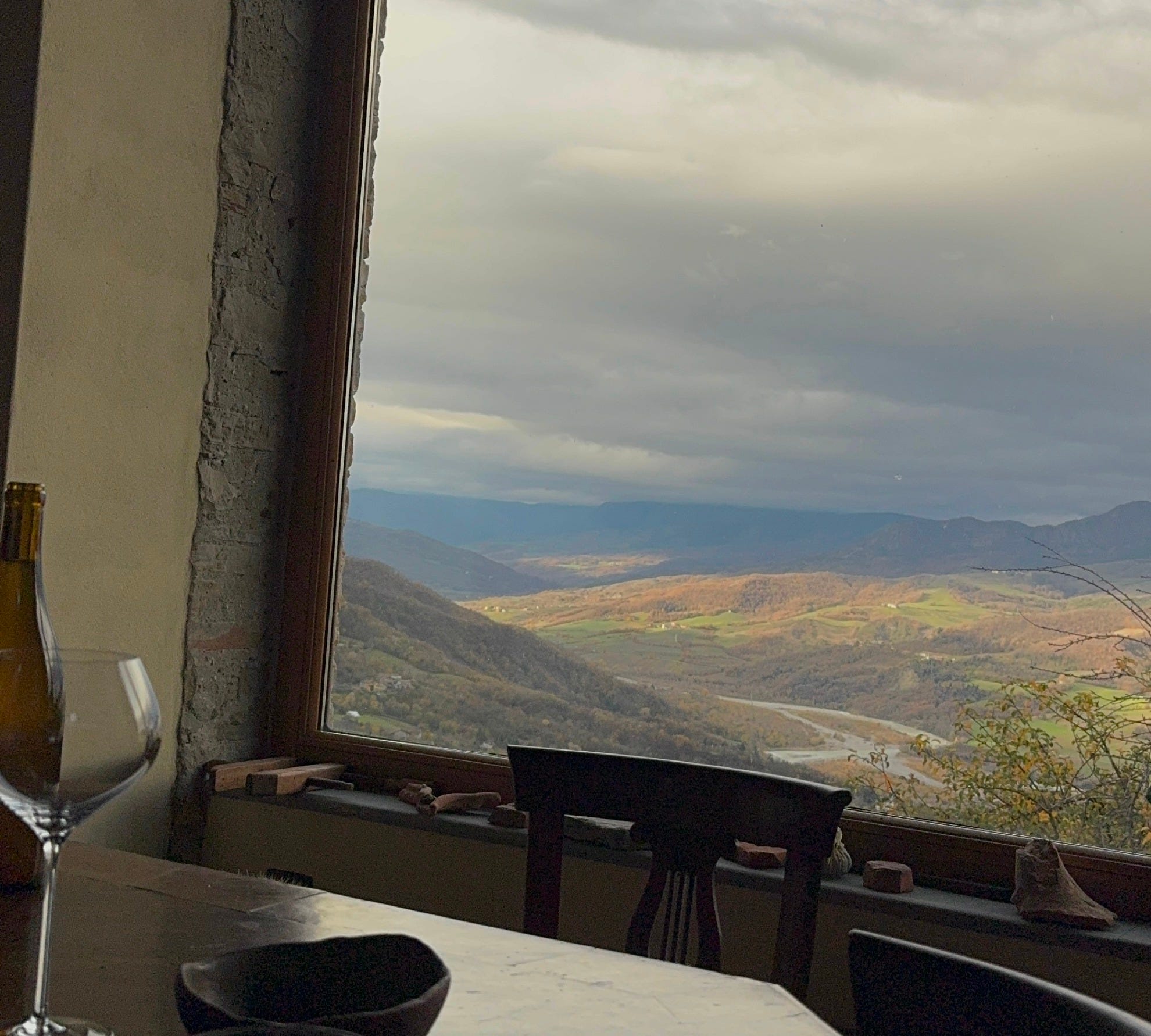
View of Val Trebbia from the tasting table at Denavolo, November 2025
Every stop on the trip was remarkable in its own way — from the warm, generous welcome at Podere Pradarolo, complete with older vintages of Vej and Velius and a beautiful meal, to wandering through the idyllic, mist-shrouded vineyards of the Donati family, to the spontaneous post-dinner ‘sjoel’ tournament at Valli Unite. But the visit to Giulio Armani of Denavolo carried a particularly special weight.
Giulio has been making unsulfured wines since the 1980s, working more-than-organic vineyards in the Colli Piacentini along the Trebbia River near Piacenza. Besides being the winemaker at the cult estate La Stoppa and running his own Denavolo project since 2005, he is a mentor to many in the region, young and old alike. We were familiar with Giulio’s reputation, but the combination of his striking presence and quiet composure, together with the panoramic view over the Val Trebbia from his living room, immediately put us at ease — as if we were visiting a sage.
Giulio, who says say more with a single glance than with a paragraph of words, calmly poured us his new wines. First we tasted the soft, peach-toned Catavela 2024, then the heady Dinavolino 2022, followed by the savoury-fruited Mansano 2021 and the tropical Mansano 2022, finishing with the towering Dinavolo 2022. Even though we’ve worked with Giulio’s wines over many vintages and have happily drunk them for years, the wines showed completely differently from how we thought we knew them. Each one seemed to glow in the glass, and tasted that way too: crystal-clear in aroma and flavor, with precise, unmistakable taste- and smell-notes, from passionfruit and melon to orange blossom, jasmine and yuzu.
The fact that Giulio’s vineyards are extremely high for the Colli Piacentini, reaching up to 700 meters above sea level and planted on limestone-rich soils, gives the wines an enormous freshness and drinkability, especially compared to other wines from the lower parts of these hills. Their textures were also less ‘big’ or ‘grippy’ than we often mentally associate with Giulio’s wines. During this attentive, tranquil tasting we understood that Giulio is making wines at the highest level — wines from which we still have much to learn. The more you learn, the less you know…
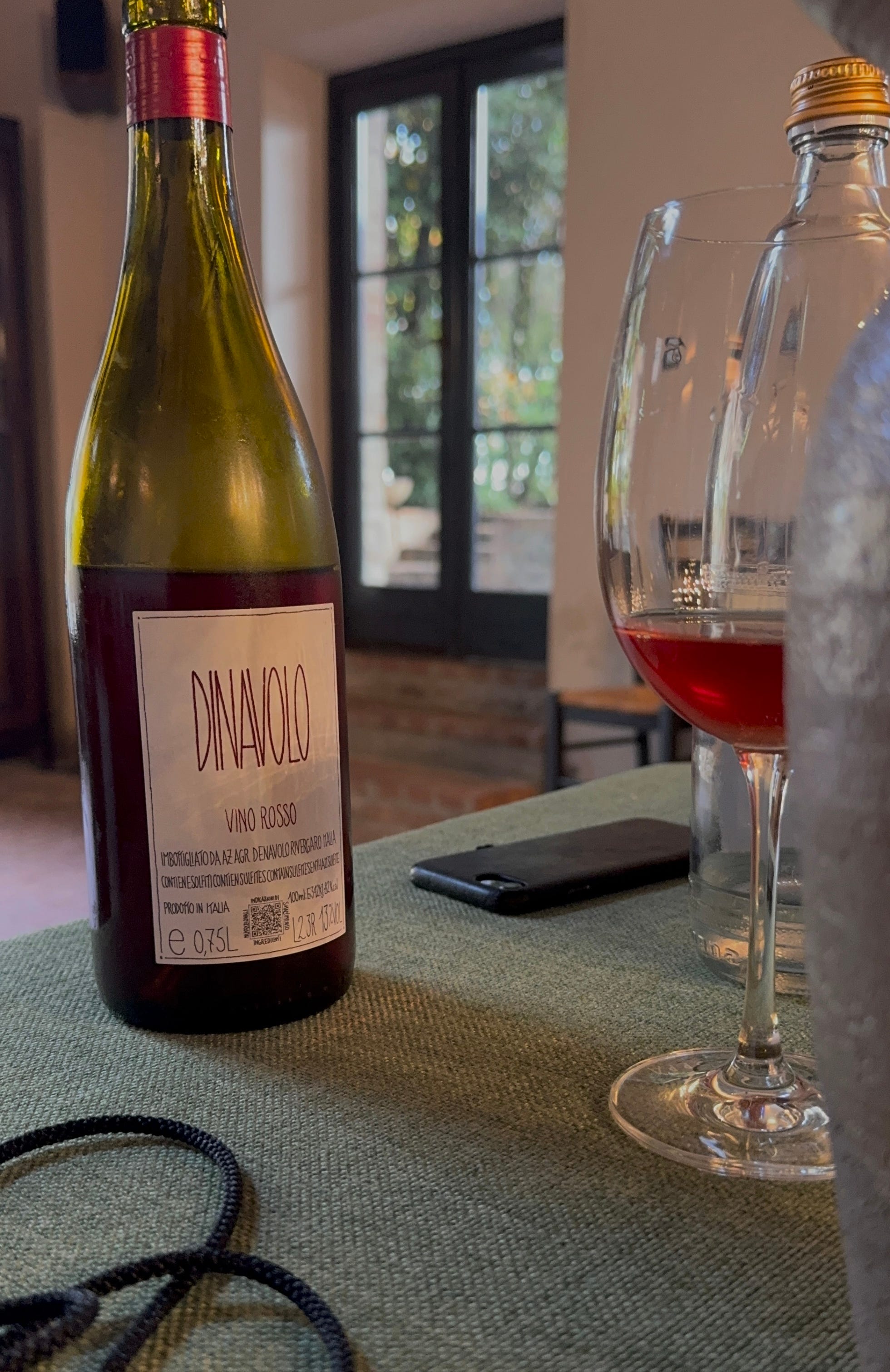
After lunch we tasted another twenty or so of Giulio’s wines, with which he — without many words — flexed his Denavolo muscles and confirmed just how beautifully his wines age. We tasted Catavela vertically back to 2013, tasted a Dinavolino 2018 (!), Dinavolo 2016 and 2009, and we also tried his new wines Ciliega 2024 (100% Ortrugo) and Mièga 2023 (100% Marsanne), each more delicious than the last, full and complex, savory yet fruity, but all highly digestible. As the final cherry on top, Giulio poured us the 2023 of his Dinavolo Rosso, which for us became the wine of the entire trip. Dinavolo Rosso is made of orange Pinot Gris blended with direct-pressed Barbera in this vintage — a brilliant wine with devilish drinkability thanks to its pleasant cranberry fruit, Barbera acidity, blood-orange bitters, tomato-like savoriness, a punch of volatile lift, and tremendous length. We left in silence; Giulio smiled.
Dinavolo Rosso 2023, November 2025
ERIKA & SHUN MINOWA
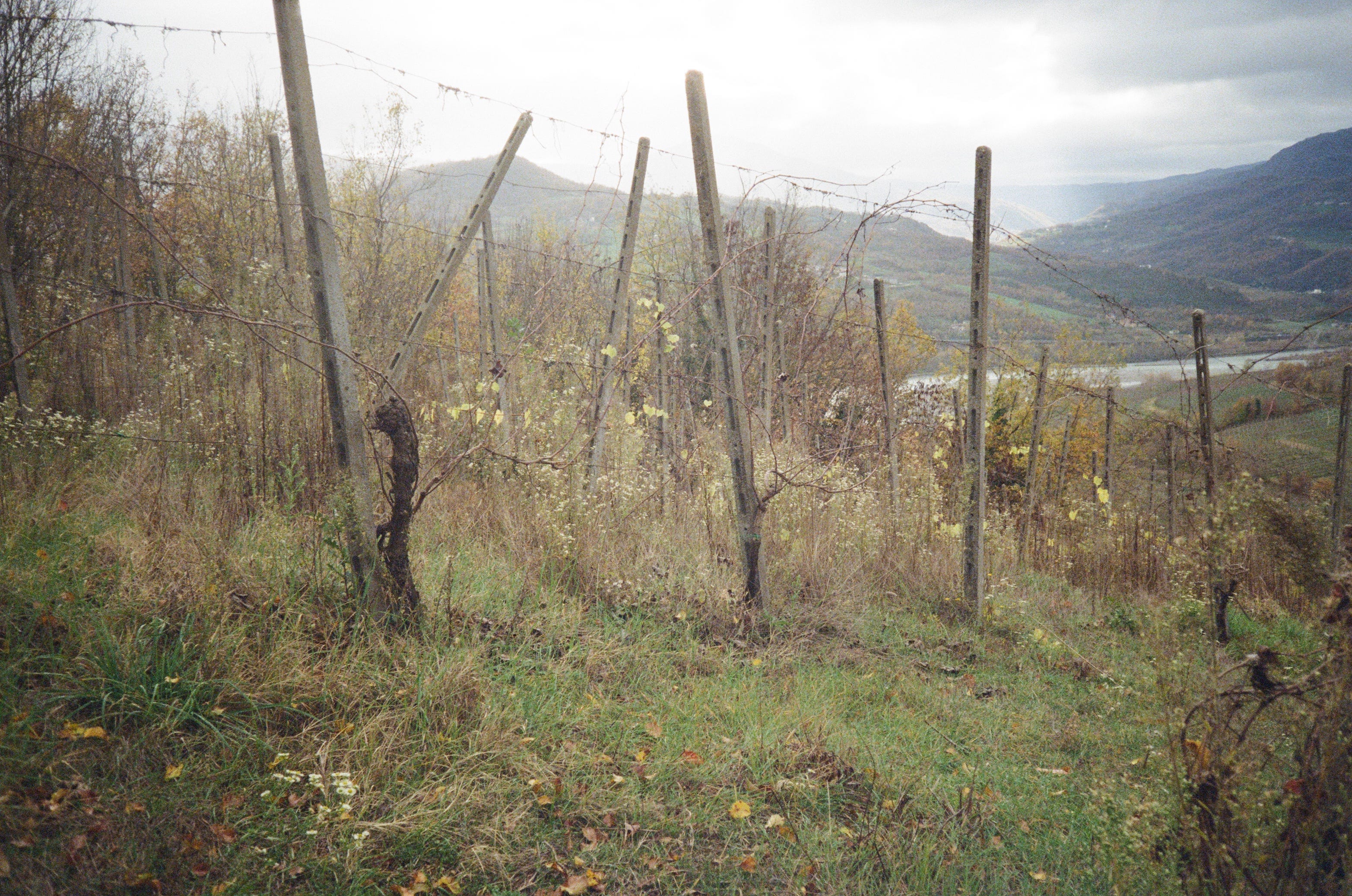
Between our visits to Denavolo and Valli Unite, we also stopped by Erika, Shun Minowa’s partner, on the opposite side of the Trebbia River in the same valley as Giulio. There, a small shipment of the new Jai Guru Deva 2023 destined for the Netherlands was already waiting — and the wines have now finally arrived here.
Shun learned winemaking at La Stoppa, Vino del Poggio, and Denavolo, and, like his mentors and fellow local winemakers, he focuses on producing long-macerated, long-élevage orange wines from a broad blend of grape varieties grown in his Trebbia Valley vineyards. Jai Guru Deva 2023 is made from a similar blend of grapes that Shun’s mentor Giulio Armani also uses at La Stoppa and Denavolo. Varieties including Ortrugo, Malvasia di Candia Aromatica, Marsanne, and Trebbiano from a single vineyard undergo extended skin contact and are then aged in glass demijohns, a concrete cuve, stainless steel tanks, an acacia foudre, and old oak barrels — until the wine reaches Shun-san’s ideal expression.
Shun’s wines are savory and slightly more rugged than Denavolo’s, yet they still clearly recall the style of his mentors’ orange wines.
Get in touch if you’re interested; we’re happy to provide more details and will aim for a fair allocation.
In the vineyards at Erika’s & Shun’s, November 2025
QUICK NEWSFLASH 3: OTTER’S PET NAT BLANC INCOMING
Just as with the other two newsflashes, we announced the arrival of the orange Pet Nat Blanc from Domaine Otter last month already; fortunately, this wine will be available online starting in March. Below you’ll find the text from the previous mailing.
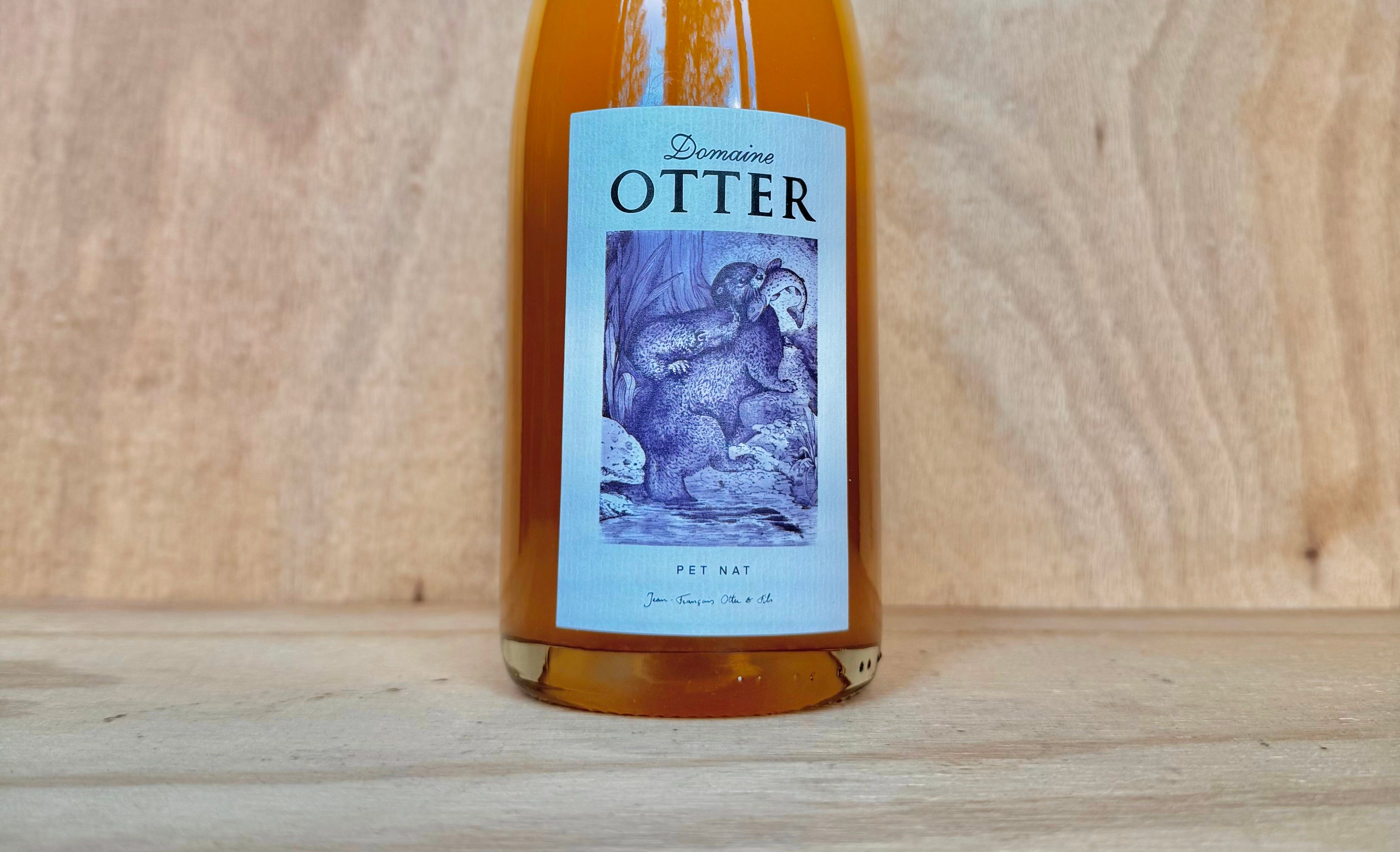
More good news in the sparkling category: Domaine Otter’s Pet Nat Blanc 2022 is on its way again! After our November tasting, the bottles flew off the shelves, but from mid-month we’ll be able to distribute this fantastic wine widely again. Otter’s Pet Nat is made from Muscat, Pinot Blanc, Riesling, and Gewurztraminer, making it perfumed and delicious. Moreover, it’s also stable and affordable, so we are expecting lots of action the coming months, and assume we’ll drink a lot of it on Kingsday?
Domaine Otter’s light-orange Pet Nat Blanc 2022
SUNDAY LUNCH WITH MILAN GATARIC AT CORNERSTORE (SUNDAY 29 MARCH)
Milan at Cornerstore during the Zuiver wijnen 10-year anniversary, November 2023
On Sunday 29 March, chef Milan Gataric (Restaurant Lux, Rotterdam) will cook a Central-European inspired menu at our friends’ venue Cornerstore, where we will serve Central and Eastern European wines alongside the dishes.
Milan will be serving, among other things, cornbread, burek, Serbian prebranac (slow-baked white beans with onion, garlic and Hungarian paprika), braised lamb with spring vegetables, and rice pudding.
March promises to be a fun and lively month, with new winemakers, tastings and events, and plenty of fresh wines (and alcohol-free drinks!). We are gradually preparing the move to our new home at De Ruyterkade 143, and this month we also welcome our new colleague Luna, who will mainly be taking care of the new location.
In any case, we hope to raise a glass of Absurde Génie together at the new venue for the first time on Tuesday 24 March. If you catch us working on the renovation earlier, please feel free to step inside and say hello. For questions or requests, we are available throughout the month via the usual contact channels. See you soon!
Warm regards, Dick, Figo, Job, Luna, Merijn, Olivier & Tom